Share

The Grant ecocool range of refrigerated and heating circulating baths provides both active cooling and precise heating in a single, energy-efficient unit. Each system combines a compact chiller/compressor with an advanced thermostat and integral circulation pump, delivering accurate temperature control over a wide range of negative and positive temperatures.
Ecocool baths are supplied as ready-to-use kits with accessory hosing, clips and connectors, and are designed for laboratory, research, industrial and educational applications where reliable temperature control of instruments, reactions or samples is required.
- Active cooling and heating across the entire working range (no separate chiller required)
- Typical temperature ranges (model dependent): approximately –20 °C to +100 °C (ecocool 100R)
- High temperature stability (around ±0.05 °C for the 100R model)
- Integrated circulation pump for internal bath circulation or external closed-loop applications
- Energy-efficient design with “eco” operating mode, reducing power consumption versus conventional compressor-only systems
- Modern user interface with digital display, presets, timer functions and alarms for high/low temperature
- Robust stainless steel tank with compact footprint, designed and built in the UK
- Supplied as a complete kit with hoses, clips and connectors, ready for installation
Typical applications include temperature control of reaction vessels and jacketed glassware, instrument cooling for rotary evaporators or chromatography systems, sample conditioning, QC testing and general laboratory heating and cooling tasks.
The ecocool range is well suited for laboratory, research, industrial, and educational uses — anywhere you need to circulate a fluid at controlled temperature for reactions, sample conditioning, or instrument cooling (e.g. for rotary evaporators, chromatography systems, photometry, etc.).
Grant positions the ecocool line as energy-efficient: they claim up to 80% energy savings compared to standard compressor-only cooling systems.
They currently list two main models in the ecocool line: 100R and 150R
Key Features & Functionalities
Here’s what makes ecocool circulators distinct:
-
Active cooling across the entire temperature range
The cooling system works in tandem with the heating/thermostat, so you can move between positive and negative temperatures without a separate chiller. -
Wide temperature ranges
- ecocool 100R: approx. –20 °C to +100 °C
- ecocool 150R: approx. –30 °C to +150 °C -
High stability / precision
Temperature stability in the order of ±0.05 °C (100R) or ±0.02 °C (150R) depending on model. -
Energy efficiency / Eco mode
The “eco mode” optimises compressor usage so that the bath cooling system is used only when necessary. This avoids constant compressor cycling and reduces power draw. -
Integrated pump / circulation
Allows fluid circulation within the system (flow rate, pump pressure). -
User interface & control
Full-colour TFT / QVGA displays, presets, timer, alarms for high/low temperature. -
Accessories included / ready-to-use kits
Supplied with standard tubing, clips, connectors, insulation, etc. -
Warranty & support
Grant advertises a 4-year warranty on many ecocool units. -
Safety features
Over-temperature cut-out, alarms, safety interlocks, and design so that thermostat and chiller don’t operate independently (i.e. to avoid freezing or overheating).
Typical Technical Specifications (100R / 150R Models)
Below is a comparison of key specs for the two main ecocool models, based on Grant’s published data:
Use Cases & Advantages
Where it’s ideal:
- Reaction temperature control for small-volume chemistries
- Cooling for instrument loops (e.g. HPLC, chromatography, photometry)
- Replacing tap water cooling systems (eco-friendly alternative)
- Laboratory teaching / education use
- Biological / biochemical workflows needing precise temp control
- Applications requiring both heating and cooling in one unit
Why choose ecocool over separate chillers / baths:
- More compact and integrated solution (one unit for heating + cooling)
- Significant energy savings (claimed up to 80 %) by optimising compressor usage and avoiding over-run cooling cycles.
- Fewer plumbing / footprint overheads (single unit, tubing, less complexity)
- Ready-to-use with accessories included (hose, clips, connectors)
- Warranty and service support from a known lab brand
Shipment
Benefit from reliable delivery options
Every day, we ship our laboratory equipment throughout Nigeria and internationally. We work with trusted and experienced logistics and courier partners to ensure safe and timely delivery. Shipping costs and delivery times depend on the items ordered and the recipient’s location. Alternatively, you may arrange to collect your order in person by appointment. Below is an overview of our shipping options and policies.
Shipping within Nigeria
All goods are insured as standard up to a value of ₦ equivalent of €25,000. Shipping costs are calculated based on the weight, dimensions, value of the shipment, and delivery destination within Nigeria. For detailed shipping information, please contact us directly—we will be happy to assist.
International shipping
For accurate international shipping costs, we require details of the specific product(s) you wish to order.
Please contact us by telephone or email for a tailored quotation.
Freight forwarding, sea or air freight
For large, heavy, or specialized equipment, we provide personalised quotations for road freight, sea freight, or air freight. Taking current logistics conditions into account, we aim to offer the best possible price-to-performance ratio.
Incoterms 2020
All shipments are handled in accordance with Incoterms® 2020 (ICC). Please contact us to confirm and agree on your preferred delivery terms.
Self-collection
If required, you may collect your goods in person by prior appointment. Please note that pricing and availability may vary between Nigeria and other countries.
Standard deliveries
Standard shipments within Nigeria are handled by reputable courier and logistics providers. Upon request, we can also arrange alternative carriers to meet specific delivery requirements.
Insurance
All deliveries are insured up to a maximum value of ₦ equivalent of €25,000. If the value of your goods exceeds this amount, we will contact you to arrange additional insurance coverage.
Delivery time
Delivery times depend on product availability and order volume. High-demand items may be subject to delays beyond our control. If you require urgent delivery, please inform us in advance, and we will do our best to accommodate your request.
Q: Saves time
A: This reason might be the most obvious, but it’s a clear benefit of an FAQ page. Not only does the FAQ page save customers time, but it also saves employees time as well. Having an FAQ page ensures customers don’t have to sit on the phone for hours waiting for simple answers, and employees don’t have to individually answer all questions.
Q: Earns trust
A: Information is available at the click of a button, but as we all know, information is not always true. Because of this, customers are more skeptical than ever before. They hunt for products by sifting through reviews, looking at the product on multiple websites, and doing price checking across the internet.
Q: Provides new insights
A: It’s difficult to get into the head of a shopper. Some buy on impulse, and others buy after thorough research. By tracking the clicks on your FAQ page, you can gather insights about your product or service that you didn’t know before. You can then inform your product team of these insights. From there, the product team can make changes to improve the product or experience.
Q: Drives internal page views
A: If you want your FAQ to be extremely thorough, which it should be, you can link to resources within your FAQ for your customers to find out more information. Whether you link to a blog that goes into more detail or a product page, this content helps the shoppers get the full story before making a purchase.
A: Prevents negative reviews
A: When looking through negative reviews, there’s almost always one thing in common: the problem could’ve been avoided.
Related Products


The SBB Aqua Plus boiling baths are robust, reliable and provide continuous 100ºC operation. The range consists of four models to suit a range of applications and any budget.
- Adjustable energy regulator provides steady boiling
- Constant level device maintains liquid level
- Robust and reliable design to withstand everyday wear and tear
- Simple, intuitive controls – quick and easy to set temperature
- Choice of sizes to suit individual applications
- Non-drip polycarbonate lid included as standard
Applications
- Clinical, microbiology and pathology labs – media preparation
- University research/teaching – tissue culture preparation, warming tissue culture media
- Industrial laboratories – equipment sanitisation, sample preparation for immunoassays
- Science education in schools/universities – practical science demonstration and experimentation
Specifications
|
SBB Aqua 5 Plus |
SBB Aqua 12 Plus |
SBB Aqua 26 Plus |
|
| Dimensions (h x d x w) | 375 x 250 x 390mm | 440 x 385 x 390mm | 445 x 600 x 390mm |
| Capacity | 5L | 12L | 26L |
| Temperature range | 100ºC only | 100ºC only | 100ºC only |
| Working area | 145 x 290mm | 315 x 290mm | 495 x 290mm |
| Min/Max liquid depth | 50/125mm | 50/125mm | 70/175mm |
| Temperature setting/energy regulation | Analogue | Analogue | Analogue |
| Safety | Two fixed thermal cut-outs | Two fixed thermal cut-outs | Two fixed thermal cut-outs |
| Heater power – 230V | 1500W | 1500W | 2000W |
| Heater power – 120V | 1300W | 1350W | 1350W |
| Supply voltage | 120 or 230V | 120 or 230V | 120 or 230V |
| Weight | 5.5kg | 7.8kg | 11kg |



This range of boiling baths has been enhanced to include drain tap and clear lift off lid. Designed for applications that require continuous boiling. This bath also has the flexibility where the control can be regulated from a gentle simmer to a vigorous boil.
Comprising of a stainless steel tank housed in a durable paint finished outer case. Painted surfaces feature a tough anti-bacterial finish with good chemical resistance. Complete with a removable stainless steel perforated false base.
The digital bath is fitted with a sheathed immersion element. With the heater directly immersed in water it provides rapid boiling. A standard feature is a constant level device, which maintains a fixed level of liquid thereby eliminating the need to regularly top up the bath.
Technical Specifications
| Product Code | NE1BD-14 | NE1BD-18W | NE1BD-28 |
| Chamber Capacity | 14 Litres | 18 Litres | 28 Litres |
|
Temperature Range |
Simmer 80°C to boiling at 105°C | ||
| Temperature Control | Digital, LED display showing actual or set, resolution 1°C | ||
| Heater Power (220-240V) | 2500W | ||
| Voltage | 230V models available 50-60Hz | ||
| Water Level Alarm | Features low liquid level float device, heating automatically suspended | ||
| Raise and Lower Sterilising Tray | ❌ | ✅ | ❌ |
| Clear Lift Off Lid Fitted | ✅ | ||
| Drain Tap Fitted | ✅ | ||
| Constant Level Device | ✅ | ❌ | ✅ |
| Dimensions | |||
| External (mm) | 362w x 332d x 290h | 538w x 332d x 290h | |
| Internal (mm) | 325w x 300d x 150h | 325w x 300d x 200h | 500w x 300d x 200h |

Controls
Digital, LED display showing actual or set, resolution 1°C

Heating/Reducing Energy Use
The bath can control the amount of boiling from a gentle simmer to a vigorous boil. It is recommended that to achieve optimum performance the bath should be covered with a lid or layer of polypropylene spheres. Covering the bath with a lid also reduces energy consumption and running costs.

This range of boiling baths has been enhanced to include drain tap and clear lift off lid. Designed for applications that require continuous boiling. This bath also has the flexibility where the control can be regulated from a gentle simmer to a vigorous boil.
Comprising of a stainless steel tank housed in a durable paint finished outer case. Painted surfaces feature a tough anti-bacterial finish with good chemical resistance. Complete with a removable stainless steel perforated false base. The bath, which is simmer-statically controlled, is ideally suited to prolonged periods of boiling.
Fitted with a sheathed immersion element. With the heater directly immersed in water it provides rapid boiling. A standard feature is a constant level device, which maintains a fixed level of liquid thereby eliminating the need to regularly top up the bath.
Technical Specifications
| Clifton boiling baths are designed for immersion of flasks, bottles and racks. |  |
 |
2 Year Warranty. |
|
|
 |
|
|
|
| Painted surfaces feature “anti-bacterial technology” which inhibits bacterial growth, improving hygiene requirements as demanded by clinical and laboratory environments. |
|
 |
The shelf in the stainless steel tank provides a stable support for vessels and can be removed for cleaning. |

Controls
Analogue dial with proportional 1 to 10 scale. Illuminated on/off switch and heater indication lamp.


 |
2 year warranty as standard and we also offer free advice and support for our baths. |
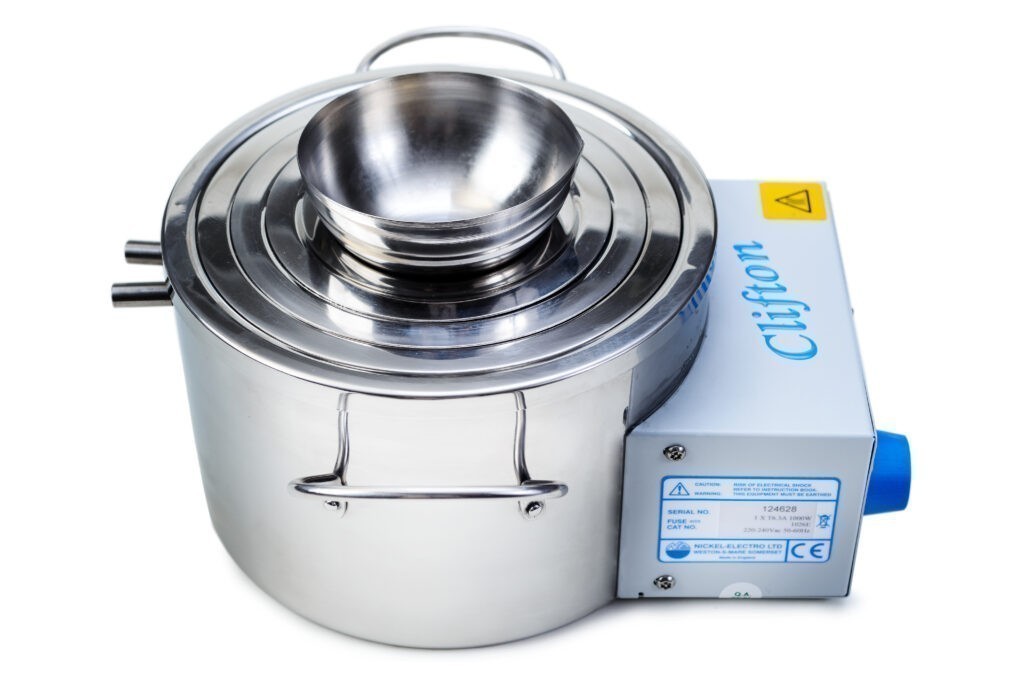
Stainless steel round boiling baths. 1026ER regulates from a gentle simmer to a vigorous boil, whereas the 1026E continuously boils. Both fitted with a sheathed immersion heater and constant water level device, with resettable thermal cut out for low water level condition. Supplied with a set of rings to vary the aperture diameter accommodating different sizes of vessels such as evaporating dishes, glassware and round bottom flasks heated by steam.
The steam produced provides an effective source of heat for samples:
- That may be otherwise thermally damaged by a naked flame.
- Used for applications to distil/concentrate liquids, melt agar and other solids.
- Metallurgical analysis, protein analysis and bacteriological examinations.
Technical Specifications
 |
Concentric Rings Center ring - removed, aperture 30mm diameter hole
|
Features and Benefits
|
 |
| Clifton sonicating water baths are designed with high power piezoelectric transducers ensuring maximum ultrasonic power throughout working area | Easy to clean tank |
|
|
| Supplied with comprehensive operating instructions and two year warranty. | Concealed heater and temperature sensors. |
|
 |
| Each bath is uniquely identified with its own serial number recorded on our product database. Electrically tested for safety at final inspection and a test certificate enclosed in rear of the instruction book. | A 304 spec stainless steel tank gives good resistance to many substances and a clean appearance throughout its working life. |

Heating Information
1026ER
This model regulates water from gentle simmer to vigorous boil. Always place the boiling bath on a heat proof surface. Heater indication lamp.
1026E
The bath provides constant boiling water for gentle heating of samples by steam. Always place the boiling bath on a heat proof surface. Power on indicator.


Rectangular multi place boiling baths for laboratory use with aluminium or stainless steel tanks and concentric ring lids for flexible vessel access.
- E models provide constant boiling at 100°C for gentle heating by steam.
- ER models include an energy regulator so you can adjust from gentle simmer to vigorous boil.
- Integral constant level device helps maintain stable water level during operation.
- Supplied with operating instructions and a two year warranty.


The Julabo calibration baths are precision temperature baths designed for calibration of sensors, measuring instruments and thermometers. Available in several models, they provide stable, uniform temperature control ideal for calibration tasks, QA/QC, and laboratory reference work.
Each bath features a stainless steel bath tank, reliable heating/cooling system (depending on model), and precise temperature regulation suitable for calibration applications. Models differ by bath volume and performance to suit different calibration needs.
The JULABO calibration baths are perfectly suitable for applications in calibration laboratories and conform to the requirements specified by DIN ISO 9001. The instruments provide highest temperature stability to ±0.005 °C and temperature uniformity better than ±0.01 °C.
The series include models with cooling units for working temperature ranges from -30 to +200 °C as well as calibration baths for temperature ranges from +50 to +300 °C. Reference temperature measurements can be carried out with an additional precision reference sensor. This saves additional costs of a digital thermometer.
|
Product Features
|
Product Features
|
Specifications
JULABO calibration baths are ideal for high precision calibration of sensors, measuring instruments, thermometers, etc. The instruments are certified for application in DKD laboratories and according to the requirements specified by DIN EN ISO 9001:2000.
| Model | SL-8K | SL-14K |
|---|---|---|
| Working Temperature Range (°C) | +50°C to+300°C | +50°C to +300°C |
| Temperature Stability (°C) | ±0.005 | ±0.005 |
| Heating Capacity (kW) | 3 | 3 |
| Pump Capacity Flow Rate (l/min) | 22 ... 26 | 22 ... 26 |
| Pump Capacity Flow Pressure (bar) | 0.4 ... 0.7 | 0.4 ... 0.7 |
The calibration baths in this category feature an integrated refrigeration unit and are suitable for calibration applications to -30 °C. The bath cover with openings and Viton® sleeves is already included in delivery for all models.
| Model | FK30-SL | FK31-SL |
|---|---|---|
| Working Temperature Range (°C) | -30°C to +200°C | -30°C to +200°C |
| Temperature Stability (°C) | ±0.005 | ±0.005 |
| Cooling Capacity (kW) | 0.46 | 0.46 |
| Heating Capacity (kW) | 2 | 2 |
| Pump Capacity Flow Rate (l/min) | 22 ... 26 | 22 ... 26 |
| Pump Capacity Flow Pressure (bar) | 0.4 ... 0.7 | 0.4 ... 0.7 |

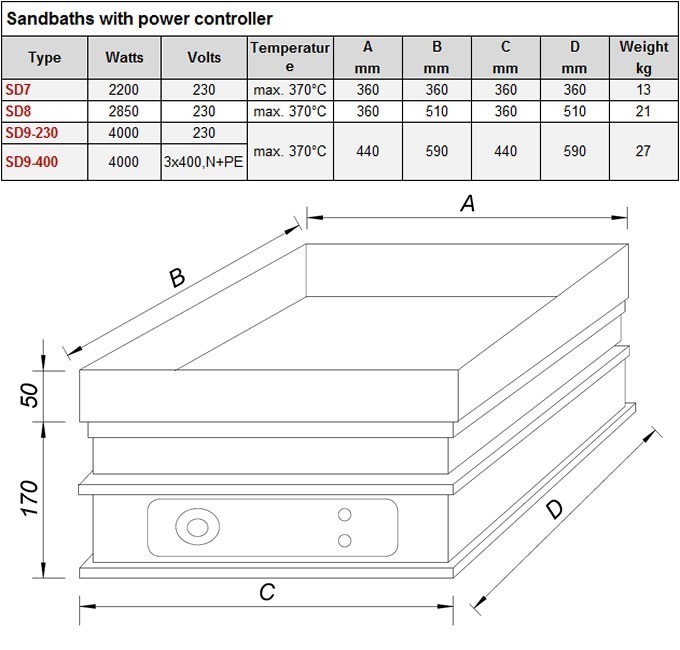
Robust electrical sand baths with stepless power control for continuous laboratory use. Quartz sand on an aluminium hotplate delivers very even, indirect heating for flasks, beakers and other vessels up to high temperatures. Durable stainless steel housing, adjustable feet and long mains cable make them practical for long‑term bench use.
Designed for uniform temperature distribution, the sand bed compensates for uneven vessel bases and absorbs liquid in case of glass breakage, improving safety and consistency in demanding workflows.
Electric sandbaths with infinitely variable temperature control with or without thermostatic control in robust design for continuous operation.
The sandbaths consist of an aluminium alloy hotplate with a screwed-on, sealed stainless steel frame with a usable height of 50 mm. Filling in quartz sand allows vessels with uneven bottoms to be heated. In case of glass breakage, the liquid is absorbed by the sand. The sand lies directly on the hotplate to prevent unnecessary heat loss.
Due to the long-term asymmetric heating system (plate corners and edges are more heated), a very uniform temperature distribution is achieved over the entire heating surface. The housing parts are made of stainless steel; the middle part is also coated. The four housing feet are slightly adjustable in height. The approx. 1.7m long connection cable is supplied with 230V to 3300W with Schuko plug.
Due to the long-term asymmetric heating system (plate corners and edges are more heated), a very uniform temperature distribution is achieved over the entire heating surface. The housing parts are made of stainless steel; the middle part is also coated. The four housing feet are slightly adjustable in height. The approx. 1.7m long connection cable is supplied with 230V to 3300W with Schuko plug.
Robust - durable even in continuous operation
The sandbaths of type SD are equipped with a continuously adjustable power controller. The heating power is specified directly in % of the connected load.